
SiteCert · Blog
The Danger of Inspection Platforms which are Not Independent
Manufacturer-owned inspection software can turn your customer and inspection data into their sales leads. Here's what's at risk and how to protect it.
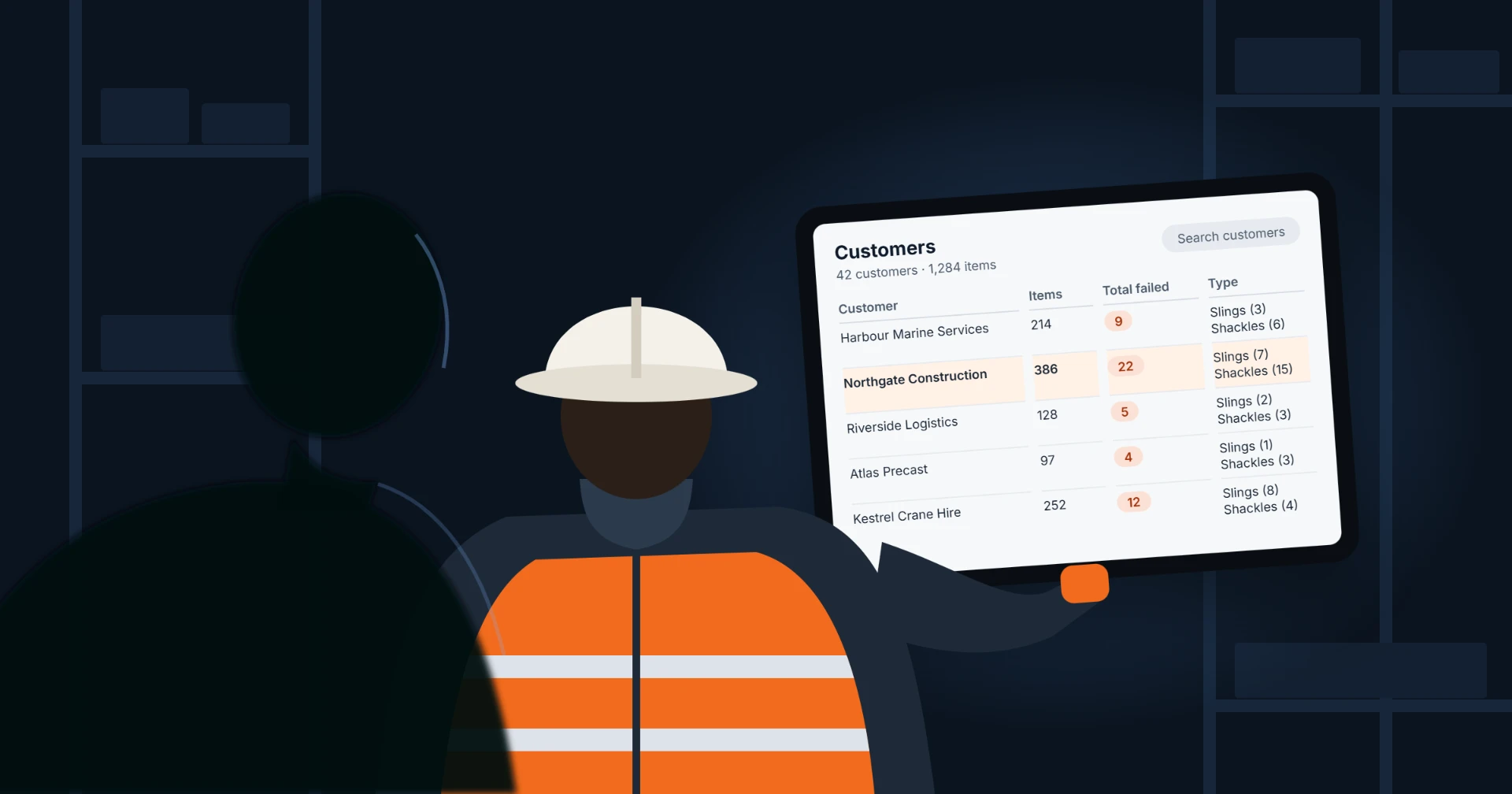
The free platform that isn't free
When a manufacturer gives you its inspection software, you pay with your data. Every tag scanned, every sling quarantined and every certificate issued becomes a record on a server the manufacturer controls.
Even if you do pay for inspection software, do check the beneficial owners as your data is valuable.
While this may save money in the short term, it has long term effects on your business - even putting it in danger or preventing you from getting a buyer when you do want to exit the business.
For independent distributors and inspection companies, that data is the business. It shows who your customers are, what they own, what condition it is in and when they will need to buy again. This post looks at what a manufacturer could do with that information, and how to keep control of it.
What your inspection records reveal
One inspection record looks harmless. Put thousands together and you get a detailed map of your market.
- Customer names, sites and contacts — Exactly who your customers are and who to call there
- Asset register per site — How much equipment each customer owns, by type and capacity
- Make and model of every item — How much of your customers' kit is the manufacturer's own versus a competitor's
- Inspection dates and intervals — When each customer's next inspection, and next spend, falls due
- Pass, fail and quarantine results — Which items are wearing out, and so which customers are about to buy replacements
- Failure reasons and photos — How products perform in the field, theirs and their competitors'
- Your inspectors, volumes and turnaround — How big your service business is and how fast it is growing
None of this needs the manufacturer to act in bad faith. It is simply what the data can show to anyone with access to it.
Look at the advent of RFID tags and the manufacturers promotion of them. They do not make sense in speeding up inspections etc, but they are for the end user to scan via an app you download. This enables the Manufacturer to know their end customer.
Cookies: following your customers home
The data you enter is only half of it. When your customers log in to the platform to view certificates, they are essentially visiting the manufacturer's website. That lets the manufacturer place cookies and tracking tags on your customers' browsers.
Here is what that makes possible:
- Retargeting ads. Advertising tags from Google, Meta or LinkedIn can add every visitor to an audience. Your customer views a certificate on Monday and sees the manufacturer's adverts and webshop offers for the rest of the week.
- Knowing exactly who is looking. On a login page, the cookie is tied to a named person at a named company. Even without a login, tools that match IP addresses to businesses can show which companies are visiting.
- Tracking behaviour. Which certificates were opened, which failed items were looked at, and how often the customer comes back. A customer studying a quarantined chain sling is a buyer in waiting, and that can trigger an email or a sales call.
- Building brand awareness. A portal with the manufacturer's logo, colours and "buy replacement" buttons puts its brand in front of your customer every time they check their own equipment. Your name fades into the background.
- Selling direct. Link the tracking to a webshop and the path is complete: your inspection finds the fault, the manufacturer's portal shows it, and the manufacturer's shop sells the replacement.
None of this needs to break the rules. Under EU and UK privacy law, non-essential cookies need the visitor's consent, and many people click "Accept all" without reading. Your customers will rarely know who is tracking them, and you won't either.
You could miss out on a sale of a replacement item with the customer going directly to the Manufacturer.
Seven ways a manufacturer could use that data
These are the tools and strategies available to a manufacturer that owns the platform your inspections run on. Some are good for the whole industry. Others depend entirely on whose side the data ends up on.
- 1Market share mapping. Count every competitor sling, chain and shackle logged in the field, by region and by customer. That gives a live view of where rivals are winning, without paying for market research.
- 2Predictive replacement and lead generation. Items close to their discard criteria, or in quarantine, are tomorrow's orders. Software can turn failed and near-end-of-life items into a ranked list of sales leads, with the customer, site and date attached.
- 3Direct selling to end users. With customer names, contacts and asset lists, a manufacturer can approach your customers directly, through its own sales team, a sister company or an e-shop, with offers timed to their inspection results.
- 4Steering replacements to its own brand. The app can suggest "recommended replacements" from the manufacturer's catalogue when a competitor item fails, nudging both the inspector and the customer.
- 5Distributor scoring. Inspection volumes, growth and customer counts show which distributors are worth backing. That data can shape pricing, rebates, territory decisions and which partner gets an exclusive deal.
- 6Product development and warranty defence. Real-world failure data improves product design. It can also be used to dispute warranty claims, or to show that failures come from misuse rather than the product.
- 7Platform lock-in and subscription pricing. Once years of certificates and asset histories sit in one system, moving out is painful. That gives the platform owner room to raise fees, bundle services or make the platform a condition of supply.
What it means for the independent distributor
The risk is that the distributor slowly becomes a data-entry service for its own supplier.
- You can be cut out. The relationship that made you valuable, knowing the customer and their equipment, now sits in someone else's database. If the manufacturer decides to sell and inspect direct, it already has your customer list, their asset registers and their renewal dates. It doesn't need to win your customers; it can simply call them. At that point your business isn't being squeezed, it's gone.
- Your margins get squeezed. A supplier that knows your volumes, customers and renewal dates has the upper hand in every price negotiation.
- Switching gets harder every year. The longer your records live on one platform, the more it costs to leave, especially if exports are partial or certificates can't be reissued elsewhere.
- Conflicts of interest multiply. Some platforms are owned or part-owned by manufacturers. If you stock several brands, at least one platform owner is likely to compete with a brand you sell.
- Your business is worth less when you sell it. A buyer is paying for your customer relationships and recurring inspection revenue. Any serious buyer will ask during due diligence where your customer and inspection data lives, who owns it and whether it can be moved. If the answer is "on a supplier's platform, under the supplier's terms", the buyer sees a business whose most valuable asset is held by someone else. Expect a lower price, tougher terms or a buyer who walks away. And if the platform owner is a manufacturer or competitor, it may be the only buyer left that already knows everything about your business.
It has happened before
Going direct once the customer data is in hand is a familiar move. Other industries show how quickly the middleman can be squeezed out.
- Sportswear: Nike. From 2017 Nike shifted to selling direct through its own stores and apps. In October 2019 it wrote to dozens of UK independent retailers to say it would end their supply agreements by 2021, because their business was "no longer aligned" with its distribution strategy. The aim was for half of Nike's sales to come through its own shops and website (Retail Gazette; TheMDS). Independent shops that had built their business around the brand faced losing it.
- Car retail: the agency model. From 1 January 2023, Mercedes-Benz moved UK retail sales to an agency model. Dealers no longer buy and resell cars; the manufacturer sets the price and owns the sale, and the dealer hands over the keys for a fee (UHY).
- Online marketplaces: Amazon. The European Commission investigated Amazon from July 2019 for using non-public data from independent sellers on its platform to benefit its own retail business. In December 2022, with no finding that it had broken the law, Amazon agreed legally binding commitments not to use that data (SCL). The lesson: the company that runs the platform can see what its users do, and is tempted to compete with them.
Inspection data is no different. Whoever owns the platform holds the map of your market.
How to protect your data
Before you sign up to, or stay on, any inspection platform, get clear answers to these questions.
- Who owns the data? The contract should say that inspection records, asset registers and customer details belong to you, not the platform.
- Who owns the platform? Check the provider's shareholders, not just its brand. In the UK, shareholders and people with significant control are free to view on Companies House. In Ireland, shareholders appear in annual returns filed with the CRO, but the beneficial ownership register is no longer open to the public.
- Who can see your data? Ask whether the provider, its shareholders or any related company can access, analyse or aggregate your records, even "anonymised".
- Can you export everything? You should be able to take every record, certificate, photo and history in a standard format, at any time, without a fee.
- What happens when you leave? Agree a notice period, an export window and confirmed deletion of your data afterwards.
- Is the system brand-neutral? It should handle every manufacturer's equipment equally, with no built-in product suggestions.
- Where is the data held? Confirm where it is hosted and that it is handled under GDPR, with you as the data controller. The platform should act only as your processor, using your data on your instructions and not for its own purposes (Article 28 GDPR).
The simplest protection is a platform with no stake in what you sell. A brand-neutral, independently owned system keeps your customer relationships and inspection history where they belong: with you.
Your data is your business
Manufacturers have every right to build software and collect data on their own products. Distributors have the same right to decide who sees theirs.
Your inspection records are a full picture of your customers and your service business, built up over years. Before you hand them to a platform, check who owns it, read the data terms and make sure you can leave with everything.
SiteCert's experience with manufacturers
Sitecert have been courted through out the years going back to 2010 by Manufacturers looking to utilise Sitecert and ultimately invest in the platform.
Knowing that even a small investment removes our independence, we declined.
As acquisitions in the sector become more common, we have seen new owners move acquired businesses onto independent inspection platforms like Sitecert to protect their investment. In our experience, buyers want customer and inspection data held on systems their group controls.
Sitecert provides an independent inspection platform. This article is general information, not legal advice. Take your own advice on contracts and data protection.